Introduction
When an enterprise buyer reviews your startup’s security posture, they are not only checking whether you can produce a SOC 2 report or complete a questionnaire quickly. They are checking whether your answers align with the following controls: cloud posture, endpoint visibility, access reviews, VAPT remediation, audit logs, and continuous monitoring.
That is why choosing the best compliance automation software 2026 is not just a tooling decision. It is a trust decision. The wrong platform can make your audit workflow look organized while the security layer that supports it stays thin.
The spreadsheet is not the problem. The evidence is.
For lean SaaS teams, the real buying question is simpler: Will this tool help you answer the next enterprise security review with current, defensible proof? If the answer depends on screenshots, old reports, and manual follow-ups across five systems, the compliance workflow has not yet been solved. It is just better organized. That distinction changes how you judge the market.
TL;DR Box
- The best compliance automation software in 2026 should not only collect evidence for SOC 2, ISO 27001, HIPAA, PCI, and security questionnaires. It should help teams prove that the controls behind that evidence are actually operating. For startups selling into enterprise, the real risk is choosing a tool that makes compliance look organized while cloud, endpoint, access, application, and VAPT gaps remain unmanaged.
Best tool is not always the fastest audit tool
The best compliance automation software in 2026 depends on your company’s stage, required frameworks, evidence sources, security maturity, and buyer pressure. A startup preparing for its first SOC 2 Type II audit may need a different system than a SaaS company that handles ISO 27001 evidence, VAPT remediation, security questionnaires, and continuous control monitoring simultaneously.
Audit speed matters. It can reduce manual evidence collection, keep owners accountable, and make the audit process less chaotic. But speed becomes a weak buying criterion when it only measures how quickly the platform prepares artifacts, not whether those artifacts still reflect the live control environment.
That is the trap for lean SaaS teams. A tool can make evidence collection easier without making the underlying security posture easier to trust. Policies can be uploaded. Screenshots can be stored. Control owners can be assigned. The harder question is whether the evidence still maps to current access reviews, cloud posture, endpoint coverage, vulnerability remediation, and monitoring data.
| 4 proof points |
|---|
| Enterprise SaaS security reviews often pull from four kinds of evidence: a SOC 2 Type II report, ISO 27001 certification or equivalent security assurance, a current VAPT or penetration testing report with remediation status, and a completed security questionnaire such as SIG or CAIQ. The exact request varies by buyer. The pattern does not. Procurement is trying to see whether your compliance artifacts, testing evidence, and control answers describe the same security reality. |
Once you judge compliance software by what it must prove, the market stops looking like a crowded list of tools. It separates into five very different categories.
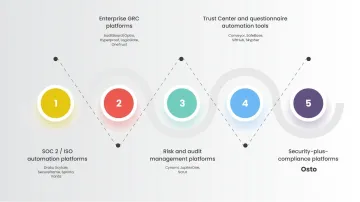
The 2026 compliance software market splits into five categories
Compliance automation software is no longer a single category. Some platforms are built around SOC 2 and ISO 27001 audit readiness. Some are enterprise GRC systems. Some focus on risk visibility, Trust Centers, or questionnaire response. Others combine security execution, VAPT, and compliance evidence into a single operating layer.
That distinction matters because “best” depends on what you need the software to do. A first-time SOC 2 team may care most about framework mapping, evidence collection, and auditor workflows. A startup undergoing an enterprise review may also need current VAPT evidence, support for security questionnaires, endpoint visibility, cloud posture, and continuous control monitoring.
Use this map to separate the market by operating need before comparing individual tools.
| Category | Common tools | Best fit |
|---|---|---|
| SOC 2 / ISO automation platforms | Drata, Scytale, Secureframe, Sprinto, Vanta | Startups preparing for common audits and evidence workflows |
| Enterprise GRC platforms | AuditBoard/Optro, Hyperproof, LogicGate, OneTrust | Larger teams managing risk, controls, audits, and governance across departments |
| Risk and audit management platforms | Cynomi, JupiterOne, Scrut | Teams that need stronger asset, cyber risk, audit, and control visibility |
| Trust Center and questionnaire automation tools | Conveyor, SafeBase, SiftHub, Skypher | Teams responding to enterprise security reviews and customer assurance requests |
| Security-plus-compliance platforms | Osto | Startups that need security, VAPT, compliance, and buyer evidence in one operating layer |
The table gives the category view. The more important question is what each category can prove, and where it may stop.
1. SOC 2 / ISO automation platforms
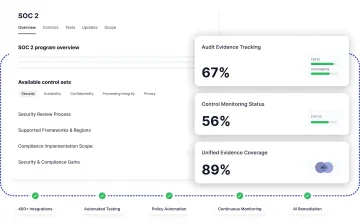
These tools are usually the clearest fit when the immediate goal is audit readiness. They help with framework mapping, evidence collection, policy workflows, auditor collaboration, and ongoing control checks for common frameworks, including SOC 2, ISO 27001, HIPAA, PCI, and GDPR.
The buyer's question is not only, “Can this help us pass the audit?” It is, “Can this also show whether the controls are still operating now?”
That is the limitation to watch. A platform can organize audit evidence without fully covering live security operations outside the evidence sources it integrates with.
2. Enterprise GRC platforms
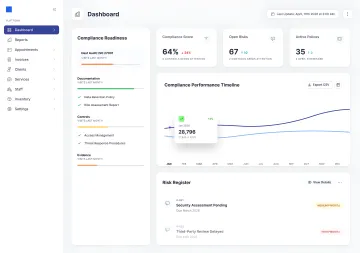
Enterprise GRC platforms are built for broader governance environments. They help manage risk registers, control libraries, audit workflows, enterprise reporting, compliance ownership, and cross-functional accountability across larger teams.
They make sense when governance itself has become complex.
For a lean startup, the risk is overhead. If the platform requires enterprise-level process maturity before your team can use it well, it may slow down the same security work it is supposed to protect.
The buyer questions: “Will this fit our team size, or create a governance system we cannot maintain?”
3. Risk and audit management platforms
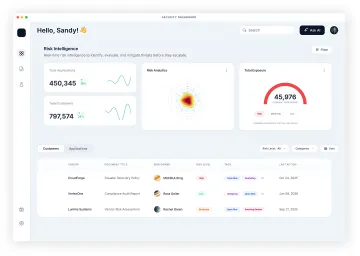
Risk and audit management platforms sit closer to the security-risk layer. They help teams connect assets, risks, controls, findings, and remediation workflows, depending on the platform’s scope and integrations.
This is useful when the problem is not just audit preparation, but visibility: what assets exist, what risks matter, which controls apply, and which findings need action.
The gap to check is coverage. Some platforms help you see and manage risk, but may not directly secure cloud, endpoint, network, application, access, and VAPT layers themselves.
The buyer questions: “Does this connect risk findings to remediation and evidence?”
4. Trust Center and questionnaire automation tools
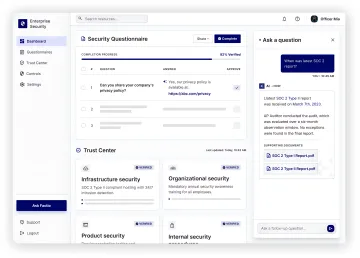
Trust Center and questionnaire automation tools solve the customer assurance problem. They help teams share security documents, maintain a Trust Center, reuse approved questionnaire answers, and respond to enterprise reviews with more consistency.
This matters when sales teams repeatedly answer the same security questions for prospects.
The limitation is that answer management is not the same as control operation. A questionnaire response can be approved yet still become stale if the evidence supporting it is outdated.
The buyer questions: “Are the answers tied to current evidence, or just approved language?”
5. Security-plus-compliance platforms
Security-plus-compliance platforms are broader by design. They are relevant when the buyer is not only asking for compliance workflow, but also for current proof around security posture, VAPT, questionnaires, and audit-ready evidence.
This category is for teams that need security execution and compliance proof to stay closer together. That may include cloud posture, endpoint visibility, application security, network security, VAPT, compliance readiness, and questionnaire support.
The tradeoff is scope. If a team only needs a narrow audit workflow, this may be more than required. But if procurement is testing the operating security layer behind the audit evidence, the broader model becomes more relevant.
The buyer questions: “Do we need compliance workflow only, or the security layer that makes evidence defensible?”
The category matters more than the logo. Start with what your buyer will ask you to prove, then choose the software category that can produce that proof without creating another operating model your team cannot maintain.
Feature checklist most buyers use is incomplete
Most compliance software evaluations start with the same sensible checklist: framework coverage, evidence automation, integrations, policy templates, auditor collaboration, risk registers, Trust Centers, questionnaire support, reporting, and continuous monitoring.
Those are real requirements. They are just not the full test.
A platform can support SOC 2 controls, ISO 27001 Annex A mapping, HIPAA safeguards, and PCI evidence, yet still not indicate whether the control is operating cleanly in the environment today. That is where the buying checklist has to move from workflow features to control reality.
Use this as the sharper evaluation layer:
- Does the tool show where the control actually operates? - A policy mapped to a SOC 2 control is useful. A control tied to an identity provider, cloud account, endpoint fleet, WAF, API protection layer, or access review is stronger.
- Does it detect cloud drift? - CSPM matters because cloud risk changes after the audit. A storage bucket, IAM permission, exposed service, or network rule can shift between evidence reviews.
- Does it connect endpoint posture to access risk? - EDR, disk encryption, device control, and screen lock matter because endpoints often serve as the path into cloud systems and production tools.
- Does it include VAPT findings and remediation? - A current VAPT report is more useful when findings, vulnerability scanning, ownership, remediation workflows, and retesting status are visible together.
- Does it help answer enterprise security questions with live evidence? - The strongest answers show control owner, system source, evidence freshness, exception handling, logs, and remediation status.
Compliance workflow is not the same as security execution
A compliance platform may show that a control exists. It may show that a policy was approved, an owner was assigned, or evidence was uploaded.
That does not mean it manages the protection layer behind the control. Cloud posture, endpoint exposure, access paths, application vulnerabilities, least privilege, log monitoring, and VAPT remediation all require operating discipline outside the checklist itself.
Compliance is the evidence layer. Security infrastructure is the protection layer.
The hidden test is evidence quality
Screenshots and policy PDFs can be accurate and still be weak. If they are old, disconnected from system data, or missing remediation context, they do not answer the buyer’s real concern.
Strong evidence should make four things clear: who controls it, where the evidence came from, when it was last validated, and what happened when an exception or finding arose. That is the difference between audit-ready evidence and procurement-ready evidence.
| The best compliance automation software is not the one that stores the most evidence. It is the one that keeps evidence connected to the controls enterprise buyers are actually testing. |
|---|
That gap usually becomes visible at the worst moment: when an enterprise buyer starts asking follow-up questions.
How weak compliance automation breaks during enterprise review
Weak compliance automation usually breaks in sequence. Not because the tool has no value, but because it answers the audit workflow faster than it answers the buyer’s operational security question.
- The buyer asks for proof: The enterprise prospect’s security review requests a SOC 2 Type II report, a current VAPT report, evidence of MFA enforcement, a cloud configuration review, endpoint encryption status, and access review records. The ask is not random. The buyer is checking whether your compliance claims map to security controls they can verify.
- The compliance dashboard answers the framework question, not the control question: The platform shows that controls are documented, policies exist, and evidence has been uploaded. It may not show whether the WAF blocked suspicious traffic last week, whether the new S3 bucket permissions are private, or whether the endpoint added on Tuesday is encrypted.
- Evidence does not map to live controls: The team produces policy PDFs, an old VAPT report, screenshots of cloud settings from three months ago, and a Slack thread discussing access reviews. Each artifact may be real. The problem is freshness, lineage, and control mapping.
- Security review expands: Procurement escalates to the buyer’s internal security team. The follow-up questions become more specific: evidence of continuous monitoring, drift detection, remediation timelines, sub-processor review, access exceptions, and log coverage. The startup starts reconstructing answers manually.
- The deal slows: A short security review becomes a long review. The champion waits. Legal waits. Procurement waits. Momentum drops because the security answer now depends on manual proof gathering across people, systems, and legacy files.
- The control gap was always there: The compliance platform surfaced what was documented. It did not surface what was operating. The fix is not simply a cleaner dashboard. It is a security operating layer that aligns evidence, controls, remediation, and buyer responses before the review begins.
That is the gap Osto is built to close: not just organizing compliance evidence, but keeping it tied to the security controls that make the evidence credible.
Where Osto fits when compliance has to prove real security
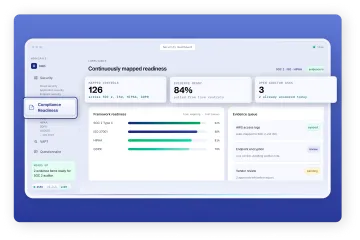
Osto is built for SaaS teams that have outgrown basic audit prep but do not want enterprise GRC overhead. It brings security, VAPT, compliance, and buyer evidence into a single operating layer, so the proof you share with auditors and procurement teams is tied to the controls actually running beneath them.
| What enterprise buyers ask for | What has to be true underneath | Where Osto fits |
|---|---|---|
| SOC 2 Type II / ISO 27001 evidence | Controls must map to real access, cloud, endpoint, application, and monitoring practices | Helps turn active security posture into audit-ready evidence |
| Security questionnaire answers | Answers need current source evidence, not copied language from old documents | Supports questionnaire readiness with evidence tied to the security layer |
| Current VAPT proof | Findings need ownership, remediation status, and follow-through | Connects VAPT with remediation and compliance readiness |
| Cloud and application security proof | Cloud posture, web/API exposure, and vulnerabilities need ongoing visibility | Covers cloud security, application security, API protection, and vulnerability visibility |
| Endpoint and access assurance | Devices, users, and access paths need to be monitored and controlled | Supports endpoint visibility, network security, Zero Trust access / ZTNA, and monitoring |
| Faster enterprise review | Evidence must be organized, current, and defensible across frameworks | Reduces scattered proof-gathering across tools, owners, and old files |
That is the practical difference. Osto is not just helping a startup look compliant on paper. It helps the team build the security layer that makes SOC 2, ISO 27001, HIPAA, PCI, VAPT reports, questionnaires, and audit evidence easier to defend when enterprise buyers start asking harder questions.
For a lean SaaS team, that is the point: fewer disconnected tools, faster procurement response, and compliance evidence backed by live security posture.
Compliance software with verifiable evidence
That matters because enterprise buyers rarely stop at the first artifact. A SOC 2 Type II report, ISO 27001 readiness, VAPT evidence, HIPAA or PCI documentation, and security questionnaire answers must all describe the same security reality. If they do not, procurement will find the gap.
Osto brings security, compliance, and VAPT into one operating layer. By connecting your cloud, endpoint, and network security directly to your audit evidence, you make compliance more than just paperwork. It’s backed by real controls. Use Osto to ace enterprise security reviews and make every buyer's answer easy to defend. Book a demo today!,
Frequently Asked Questions
What is compliance automation software, and how does it work?
Compliance automation software replaces manual evidence collection and control tracking with integrations that pull proof directly from your tech stack — cloud providers, HR tools, ticketing systems — and automatically map it to framework requirements. This keeps audit readiness continuous rather than something you rebuild every certification cycle.
What is the best compliance automation software in 2026?
The best compliance automation software in 2026 is the one that fits your frameworks, evidence sources, team size, and security maturity.
For audit-focused teams, platforms like Vanta, Drata, Secureframe, Sprinto, and Scytale can help with SOC 2, ISO 27001, evidence collection, and audit workflows. Larger companies may evaluate tools like Hyperproof, AuditBoard, or OneTrust for broader GRC needs. Risk-focused teams may look at platforms like Cynomi.
For SaaS startups that need compliance, security, VAPT, questionnaires, and audit evidence in one operating layer, Osto fits the security-plus-compliance category. That matters when enterprise buyers are not only asking whether you have compliance artifacts, but whether the cloud, endpoint, access, application, and VAPT controls behind those artifacts are actually operating.
Which compliance frameworks should a startup prioritize in 2026?
Most SaaS startups start with SOC 2 Type II for US enterprise sales and ISO 27001 for international customers. GDPR applies to any business handling EU personal data. The right starting framework depends on your target customers and industry; not every startup needs all three immediately.
What should startups look for before buying compliance automation software?
Startups should check framework coverage, evidence automation, live control monitoring, security-layer integrations, questionnaire readiness, audit workflow, and operational overhead.
A good tool should support the frameworks your buyers expect, such as SOC 2, ISO 27001, HIPAA, PCI, or GDPR. It should also help collect evidence from real systems, maintain clear ownership, support security questionnaires, and indicate whether controls are up to date.
For lean teams, the final test is usability. If the software creates another heavy process nobody maintains, it will not help when procurement asks for proof. The best fit is the platform your team can actually operate before the buyer starts asking harder questions.
Is compliance automation software enough to make a startup secure?
No. Compliance automation helps organize and prove controls, but it does not automatically secure cloud assets, endpoints, applications, access paths, or vulnerabilities.
Compliance is the evidence layer. Security is the protection layer underneath it. A platform can help map SOC 2 controls, collect ISO 27001 evidence, prepare HIPAA or PCI documentation, and answer questionnaires. But the company still needs active controls, including cloud posture monitoring, endpoint protection, access reviews, vulnerability scanning, VAPT remediation, log monitoring, and least privilege.
If the controls are not operating, the evidence becomes thin. It may pass an audit workflow, but it will struggle under an enterprise security review.
Can compliance automation tools help with cloud security and misconfiguration compliance?
Most compliance automation tools track whether controls are documented and tested, but they rely on your cloud infrastructure being properly configured. Misconfigurations in S3 buckets, IAM roles, or network security groups are real control failures regardless of what your dashboard shows. A CSPM layer that detects misconfigurations in real time is a necessary complement, especially across multi-cloud environments.
Do small businesses really need compliance automation software, or will spreadsheets work?
Spreadsheets are manageable for a single, simple compliance scope. They become a liability when managing more than one framework, multiple control owners, or recurring annual audits — where automation can save hundreds of hours and reduce the risk of evidence gaps that can delay or derail certification.